Can a beneficiary witness your will in Northern Ireland?
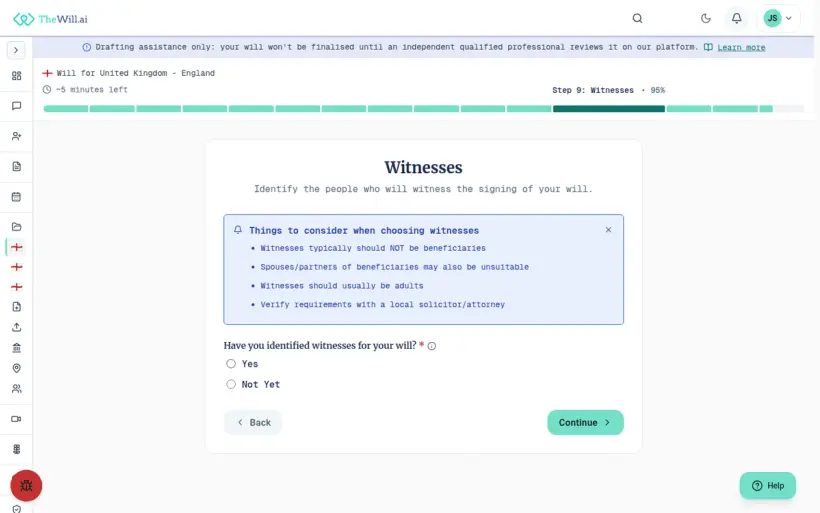
Northern Ireland has its own wills legislation rather than the Wills Act 1837, but on this specific question it lands in the same place. A beneficiary can witness a will; the gift to them, and to their spouse or civil partner, is voided unless enough other witnesses signed.
 United Kingdom - Northern Ireland
Generic UK guidance on this topic tends to point at "the Wills Act" without asking which one. Northern Ireland has not run on the Wills Act 1837 for some time, and treating the two nations as interchangeable is a habit worth breaking even when, as here, it happens to land on a similar answer.
This article is about Northern Ireland. England, Wales and Scotland each answer this question through their own separate law, and Scotland's answer is structurally different rather than merely differently worded. What follows is general information rather than legal advice: whether a particular gift survives depends on exactly who signed and how many witnesses were involved. If any of this looks close to your own will, take it to a qualified professional.
The governing instrument is the 1994 Order, not the 1837 Act
Wills in Northern Ireland are governed by the Wills and Administration Proceedings (Northern Ireland) Order 1994, which restates and modernises the law of wills for Northern Ireland in its own right. It is not a copy-and-paste of the Wills Act 1837, even where the two reach the same conclusion, and a reader who assumes every section number lines up across the border can end up citing the wrong provision.
Article 8 voids the gift, not the will
Article 8 of the 1994 Order provides that if a witness to a will is a person to whom, or to whose spouse or civil partner, property is given by the will, the gift is void so far as it concerns them, while the witness's signature still counts toward the will's validity. Three details in the wording are worth having:
- It reaches the exercise of a special power of appointment in the witness's favour, not only an outright gift
- It also voids the gift as against anyone claiming under the witness or their spouse or civil partner, so it cannot be salvaged by passing the entitlement on
- It expressly does not reach property given by way of a charge, or a direction for the payment of debts
The article also confirms that an interested witness remains competent to give evidence about the execution, and the validity or invalidity, of the will.
The structure is the same shape as the England and Wales position, and the exception is worded the same careful way: the witnessing is disregarded if the will is duly executed without that signature and without that of any other such person. A will needs only two valid witnesses, so where a third, disinterested person also signed, the will stands on the two disinterested signatures and the gift survives. A will witnessed by exactly two people, one of whom benefits under it, has nothing to fall back on.
The second half of that exception does more work than it looks. It sets aside every interested signature at once, not only the one in question, so if two of three witnesses benefit under the will, disregarding both leaves one signature, the will is not duly executed on that alone, and neither gift is rescued.
What voiding the gift does to the rest of the will
The rest of the will stands. The void gift usually falls into residue, or into intestacy if there is no residuary clause that catches it, while every other gift and appointment in the will continues to operate normally. An appointment as executor with no accompanying gift is not affected at all, since it is not a beneficial gift in the first place.
What is worth checking before a will is signed
- Whether either witness, or their spouse or civil partner, is left anything under the will
- Whether a genuinely independent third witness is available if a planned witness turns out to be a beneficiary
- Whether an already-signed will used a beneficiary as one of only two witnesses, in which case it is the gift that needs attention rather than the whole document
Where a gift has already been lost this way, the will itself does not necessarily need to be redone, though many people choose to once the problem comes to light. You can start a new will through our individual wills service, or with any provider or professional you prefer. Our guide on what happens without a will covers what happens to a gift that falls into intestacy, and if your household includes stepchildren or children from an earlier relationship, our page on wills for blended families covers the arrangements people commonly look at.
The practical rule is the same one that applies across the border: nobody named as a beneficiary, and nobody married to or in a civil partnership with a beneficiary, should be one of the witnesses. Where that cannot be avoided, take it to a qualified professional rather than assuming the exception applies.
Sources
- Wills and Administration Proceedings (Northern Ireland) Order 1994, Article 8 (opens in a new tab), legislation.gov.uk, gift to a witness or their spouse or civil partner void, the witness still competent to prove execution, and the paragraph (3) exception for a will duly executed without that signature and without that of any other such person
- Wills Act 1837, section 15 (opens in a new tab), legislation.gov.uk, cited for the England and Wales contrast and its separate extent
Written by
TheWILL.ai Team
The editorial team at TheWILL.ai, dedicated to making estate planning accessible and modern.