

Your portfolio lives in six places, none agree
A broker, an exchange wallet, a metals custodian and a pension platform each hold one true figure. Nobody holds the figure that adds them together, until someone sits down and builds it by hand.
Ask most people what their portfolio is worth and they will give you a number. Ask where that number came from and the answer is usually "I added it up last month", which is a different thing from a number any single institution can confirm, because no single institution can see the whole picture.
Six places, six sources of truth, no shared one
A brokerage account reports its own holdings and their current prices, in its own currency and its own format. An exchange wallet reports crypto balances the same way, on its own schedule, sometimes several times a day. A bullion custodian reports weight and purity rather than a market value at all, leaving the pricing step to whoever is looking. A workplace pension platform reports a projected value under its own assumptions, updated quarterly rather than in real time. A property is worth whatever the last valuation says it was worth, which could be recent or could be several years stale. A joint account held with someone else reports a total that is not entirely yours to begin with.
Each of those six sources is accurate on its own terms. None of them is wrong. The problem is that none of them was built to talk to any of the others, so the combined total exists only in whatever spreadsheet, note or mental estimate someone last assembled it into, and that assembly happens on nobody's schedule but the owner's.
Why the six drift apart between check-ins
Between one manual round-up and the next, every one of those six sources keeps moving on its own. A share price changes by the second. A crypto balance changes with every transaction and, more quietly, with every staking reward or airdrop nobody remembered they were owed. A pension value is recalculated at whatever interval its provider chooses, off assumptions the owner never sees. A bullion holding does not move in weight, only in the market price applied to it, which is a number nobody at the custodian is tracking on the owner's behalf.
A total assembled today is already describing a moment that has passed by the time it is written down, and the gap between that moment and the next check-in is exactly the period in which nobody has an accurate combined figure at all, only six accurate individual ones and a stale sum of them.
The consolidation problem is not a spreadsheet problem
The instinct is to open a spreadsheet and enter everything into one place, and that solves the layout problem: one screen instead of six logins. It does not solve the currency problem, since a brokerage figure in one currency and a wallet balance in another need converting at a rate that is itself moving. It does not solve the format problem, since a pension statement's PDF and an exchange's CSV export do not share a structure to copy from. And it does not solve the timing problem, since a spreadsheet is only as current as the last time someone opened all six sources and transcribed them, which is the same manual bottleneck as before, now wearing a single tab instead of six.
A spreadsheet answers "what did I write down", not "what do I actually hold right now across every source". The two match only for as long as nobody's holdings have moved since the last transcription, which for six independently moving sources is rarely more than a few hours.
What a consolidated view actually needs
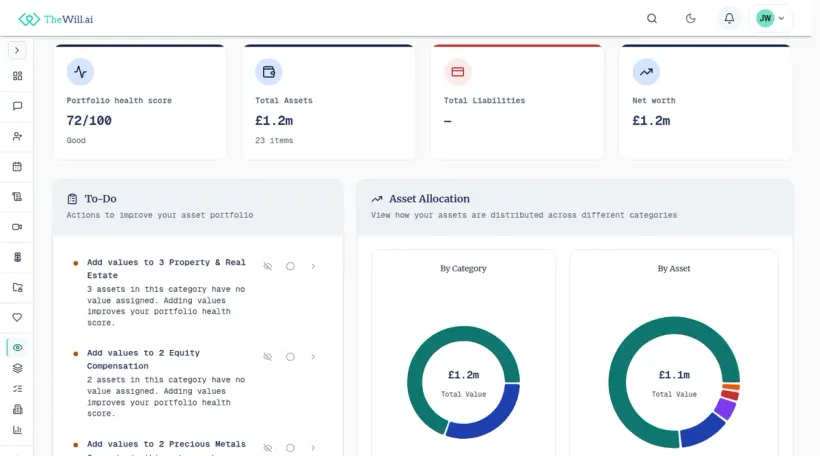
Bringing six sources into one honest figure means converting each of them at a consistent rate applied the same way across all of them, and updating the total each time you have a fresh statement or valuation to hand rather than whenever someone remembers to. That is what our asset tracker is built to do: upload a broker statement or portfolio document and it reads the holdings out of it, applies current market prices to listed investments and precious metals, and surfaces the records you have not touched in a while so nothing sits stale unnoticed.
Importing correctly today is not the end of the story either. Even a portfolio pulled in accurately can quietly drift out of step with its sources over the following weeks, one uncaught corporate action or fee at a time, which is a reconciliation problem distinct from the consolidation one and worth treating separately.
Why this matters beyond the current balance
A combined figure that is only ever accurate on the day someone manually rebuilds it is also the figure an executor or beneficiary would eventually have to reconstruct from scratch, from six separate statements, at exactly the point when the person who used to do that reconciling is no longer available to help. Our guide on what happens to an estate without a will in place touches on why a complete and current record of everything owned matters as much to the people who come after as it does day to day.
A total that was last true on the day it was written down is not the same thing as a total that is true today, and the gap between the two only grows the more sources it is drawn from. If a portfolio genuinely sits across a broker, a wallet, a custodian and a pension platform, "what do I actually hold right now" deserves an answer you can trust today, not a monthly reconstruction project.