Can a beneficiary witness your will in England and Wales?
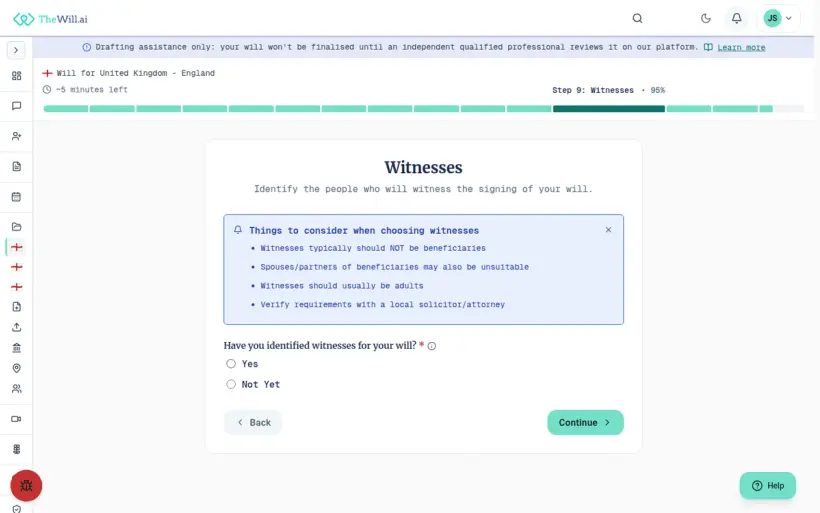
In England and Wales a beneficiary can sign as a witness, but the gift to them does not survive it. The will still stands; the witness, and their spouse or civil partner, simply lose whatever the will tried to leave them, unless a narrow statutory rescue applies.
 United Kingdom - England and Wales
A daughter helps her elderly father get his will signed at the kitchen table. Two neighbours were meant to come round, but only one turns up, so she signs as the second witness herself. The will is perfectly valid. The gift her father left her is not.
That is the specific trap this article is about, and it catches well-meaning families rather than careless ones. Nobody sets out to disinherit themselves; they just sign where they are told to sign.
This article is about England and Wales. Other parts of the United Kingdom, and other countries, answer this question differently, some of them in the opposite direction. What follows is general information rather than legal advice: whether a particular gift survives depends on exactly who signed, when, and how many other witnesses there were. If any of this looks close to your own will, take it to a qualified professional before you rely on it.
The rule that voids the gift, not the will
Section 15 of the Wills Act 1837 provides that if a will is attested by a person to whom, or to whose spouse or civil partner, a beneficial gift is given by the will, that gift is void. The witness's signature still counts toward making the will valid. What fails is only the gift to that witness, and to their spouse or civil partner at the time the will was signed.
This is a narrow, mechanical rule. It does not touch:
- An appointment as executor with no accompanying gift, since acting as executor is not itself a beneficial gift. Where a will contains a charging clause for a professional executor, section 28 of the Trustee Act 2000 has since 1 February 2001 treated what that executor is paid as remuneration for services rather than as a gift, so witnessing does not cost them their fees
- A witness who is not a beneficiary at all
- An unmarried partner of a witness, however settled the relationship: section 15 reaches a witness's wife or husband, and, since the Civil Partnership Act 2004, a civil partner, and nobody beyond that
- Anyone who signs after the will is already validly executed by two other, disinterested witnesses
That last point is where most of the confusion sits, and it is also where the escape route lives.
The 1968 Act can save the gift
Section 1 of the Wills Act 1968 provides that the attestation of an interested witness is disregarded if the will is duly executed without it, and without the attestation of any other interested witness. In practice: a will only needs two witnesses, so where a third, disinterested person also signed, the will stands on the two disinterested signatures and the gift survives.
That second limb is the part that catches people out. The rescue sets aside every interested attestation at once, not only the one being asked about. If two of three witnesses are beneficiaries, disregarding both leaves a single disinterested signature, the will is not duly executed on that alone, and neither gift is saved. Two beneficiary witnesses need two disinterested witnesses beside them, not one.
The rescue depends entirely on the arithmetic of who signed, not on anyone's good intentions. A will witnessed by exactly two people, one of whom is a beneficiary, has no spare signature to fall back on. The gift is void and nothing in the 1968 Act reaches it.
What voiding the gift actually does to the estate
The rest of the will is untouched. If the void gift was a specific item or sum, it usually falls into residue and passes under whatever residuary clause the will contains, or into intestacy if there is no residuary clause covering it. The witness keeps nothing from that gift, their spouse or civil partner keeps nothing either, and everyone else's gifts under the will are unaffected.
This is also why the rule bites hardest in small, informal signings. A solicitor's office keeps spare, disinterested staff on hand precisely so this never comes up. A kitchen-table signing among family, arranged in a hurry with whoever is in the house, has no such safety margin.
What is worth checking before a will is signed
- Whether either witness, or their spouse or civil partner, is left anything under the will
- Whether there is a genuinely independent third witness available if one of the planned two is a beneficiary
- Whether an already-signed will used a beneficiary as one of only two witnesses, in which case the gift, not the will, is what needs fixing
Where a gift has already been lost this way, the will itself does not need to be redone for that reason alone, though many people choose to replace it anyway once the problem is spotted, particularly if it affects who is left with nothing. You can start a new will through our individual wills service, or with any provider or professional you prefer. Our guide on what happens without a will covers what happens to a gift that falls into intestacy, and if your household includes stepchildren or children from an earlier relationship, our page on wills for blended families covers the arrangements people commonly look at.
The safest practical rule is the simplest one: nobody who is named as a beneficiary, and nobody married to or in a civil partnership with a beneficiary, should be one of the witnesses. If that is not possible, take it to a qualified professional rather than guessing whether the 1968 Act rescue applies.
Sources
- Wills Act 1837, section 15 (opens in a new tab), legislation.gov.uk, gifts to an attesting witness void
- Wills Act 1968, section 1 (opens in a new tab), legislation.gov.uk, the interested witness's attestation is disregarded where the will is duly executed without it and without that of any other such person
- Civil Partnership Act 2004, Schedule 4, paragraph 3 (opens in a new tab), legislation.gov.uk, which is what applies both of the above to a witness's civil partner; section 15 itself says only wife or husband
- Trustee Act 2000, section 28 (opens in a new tab), legislation.gov.uk, payments under a charging clause treated as remuneration and not as a gift for the purposes of section 15
- Thorpe v Bestwick (1881) 6 QBD 311, for the rule that the relationship is tested at the time the will is executed, so a beneficiary who marries a witness afterwards keeps the gift
Written by
TheWILL.ai Team
The editorial team at TheWILL.ai, dedicated to making estate planning accessible and modern.