Does divorce revoke your will in Scotland?
Scotland only got a divorce rule for wills in November 2016, and it is narrower than the English one it is often confused with. The former spouse is treated as having died before the testator, but an appointment of a guardian is deliberately left standing.
 United Kingdom - Scotland
A Scottish will made during a marriage says what it says, and until quite recently a divorce did nothing whatever to it. The former spouse stayed named as executor and as the main beneficiary, and the law governing the document had no view about the marriage having ended. That changed on 1 November 2016, and the change is both narrower and differently shaped than the English rule it tends to get confused with.
This article is about Scotland. England, Wales and Northern Ireland reached broadly similar destinations by different, older routes, so a rule you have read about from a UK-wide source may not describe the Scottish position accurately. What follows is general information rather than legal advice: it depends on your own dates and your own will. Anyone close to this situation should take it to a qualified professional.
Before 2016, a Scottish will survived divorce completely intact
For most of the twentieth century and into this one, Scots law had no equivalent of the English rule that strips a former spouse out of a will on divorce. A will naming a spouse as executor and main beneficiary continued to say exactly that after the decree of divorce, the dissolution of a civil partnership, or an annulment. The document did not know the marriage had ended, and neither did the law that governed it.
That silence was not an oversight so much as a reflection of how differently Scots succession law treats a spouse in the first place, through legal rights rather than through the kind of gift-based mechanism England and Wales relies on.
Section 1 of the 2016 Act, and only from 1 November 2016
The Succession (Scotland) Act 2016 changed this. Section 1 provides that where a marriage or civil partnership ends in divorce, dissolution or annulment, a gift to the former spouse or civil partner, a power of appointment conferred on them, and their appointment as executor or trustee are all treated as though that person had died before the testator. The rest of the will stands exactly as written.
The shape of that fiction is worth noticing, because it is not the English one. Scots law deems the former spouse to have died before the testator. Section 18A of the Wills Act 1837 deems the former spouse to have died on the date the marriage was dissolved. The two usually land in the same place, but they are different sentences and it is the reason a rule quoted from an England and Wales source cannot simply be read across.
Two conditions are built into the section itself. Section 1(1) requires the termination to come first and the testator to die afterwards, so a testator who dies before the divorce is completed is outside it entirely. Section 1(5) then requires the divorce, dissolution or annulment to have been obtained from a court of civil jurisdiction in the United Kingdom, the Channel Islands or the Isle of Man, or else to be one whose validity is recognised in Scotland. For a couple who married in Scotland and divorced abroad, that recognition question comes before any of the rest of this.
Section 1 came into force on 1 November 2016 and does not reach a testator who died before that date. Whether it reaches a testator who dies after it but whose divorce was obtained years before it is a question this article deliberately does not answer: the commencement regulations carry no saving provision addressing section 1, and the Explanatory Notes to the Act do not deal with the point either, so anyone whose divorce predates November 2016 should treat it as a question for a solicitor rather than as settled.
One appointment survives on purpose
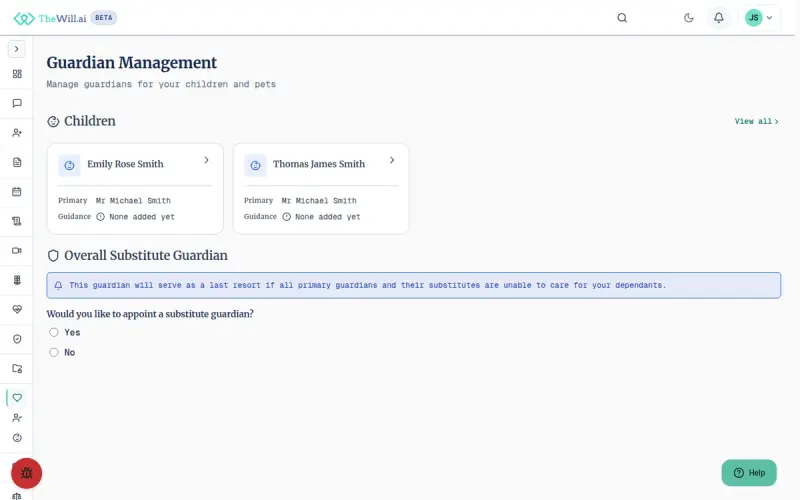
Section 1(2) carves out a single exception, and it is the one that most affects parents. The provision does not touch the appointment of a guardian, whether that guardian is the former spouse or anyone else. A will naming an ex-spouse as guardian of the couple's children keeps that appointment in force after the divorce, in the same document where the financial gift to that same person has just failed. It is not a drafting inconsistency. It is the statute working exactly as intended, on the view that who should raise a child and who should inherit money are different questions.
A clause in the will can switch the rule back off
Section 1 does not apply where the will expressly states that its provisions are to hold good regardless of the marriage or civil partnership ending. Very few home-made wills contain wording like this, because it requires the person drafting the will to have anticipated their own future divorce, which understandably few people do. Where the clause does exist, usually in a will drafted with legal advice for a specific reason, it is respected.
Separation is not divorce, and the estate can still be surprised
An estranged spouse who has never actually been divorced remains a spouse for every purpose this article covers, including the legal rights that protect a surviving spouse regardless of what the will says. A couple who have lived apart for years, entirely amicably, without ever converting that separation into a formal divorce, leaves an estate exposed to exactly the same position as a couple who separated last month. The 2016 Act only responds to the legal event, never to the practical one.
Checking which side of the line you fall on
Section 1's effect is automatic once its conditions are met, so there is rarely a decision to make about whether it applies. There is a decision to make about whether to rely on it. A will that predates a divorce, even one now governed by the 2016 Act, still contains an executor appointment that has just collapsed with no substitute named, and it still says nothing about who should now receive what the former spouse would have had.
You can start a fresh will through our individual wills service, or with any provider or professional you prefer. Readers weighing whether their document should really be drafted under Scots rules at all, particularly after a move across the border, may also find our comparison of Scottish and English wills useful groundwork before that conversation.
The 2016 Act removed one kind of surprise from Scottish succession and, by fixing a commencement date, created a narrower one of its own. Where an estate sits in relation to that date starts as a question of fact, and it stays one right up to the point where the divorce itself predates November 2016, which is where it becomes a question worth putting to a solicitor rather than settling from an article.
Sources
- Succession (Scotland) Act 2016, section 1 (opens in a new tab), legislation.gov.uk, effect of divorce, dissolution or annulment on a will, in force for deaths on or after 1 November 2016
- Succession (Scotland) Act 2016, section 1(2) (opens in a new tab), legislation.gov.uk, the guardian appointment carve-out
- Succession (Scotland) Act 2016, section 1(5) (opens in a new tab), legislation.gov.uk, the divorce must be obtained from a United Kingdom, Channel Islands or Isle of Man court or be recognised in Scotland
- The Succession (Scotland) Act 2016 (Commencement, Transitional and Saving Provisions) Regulations 2016 (opens in a new tab), legislation.gov.uk, appointed day of 1 November 2016; regulation 3 makes saving provision for other sections and not for section 1
- Succession (Scotland) Act 1964, section 10 (opens in a new tab), legislation.gov.uk, abolition of terce and courtesy and calculation of legal rights out of the net moveable estate. Legal rights themselves are a creature of the common law rather than of this Act
- Succession (Scotland) Act 1964, section 13 (opens in a new tab), legislation.gov.uk, a testamentary provision is deemed to be in full and final satisfaction of legal rights unless the will says otherwise, so a survivor chooses between the two
Written by
TheWILL.ai Team
The editorial team at TheWILL.ai, dedicated to making estate planning accessible and modern.