How TheWill.ai uses AI responsibly
TheWill.ai uses AI to make will creation more accessible and accurate, with a privacy-first approach: your answers stay on our own servers unless you consent to an outside AI provider.
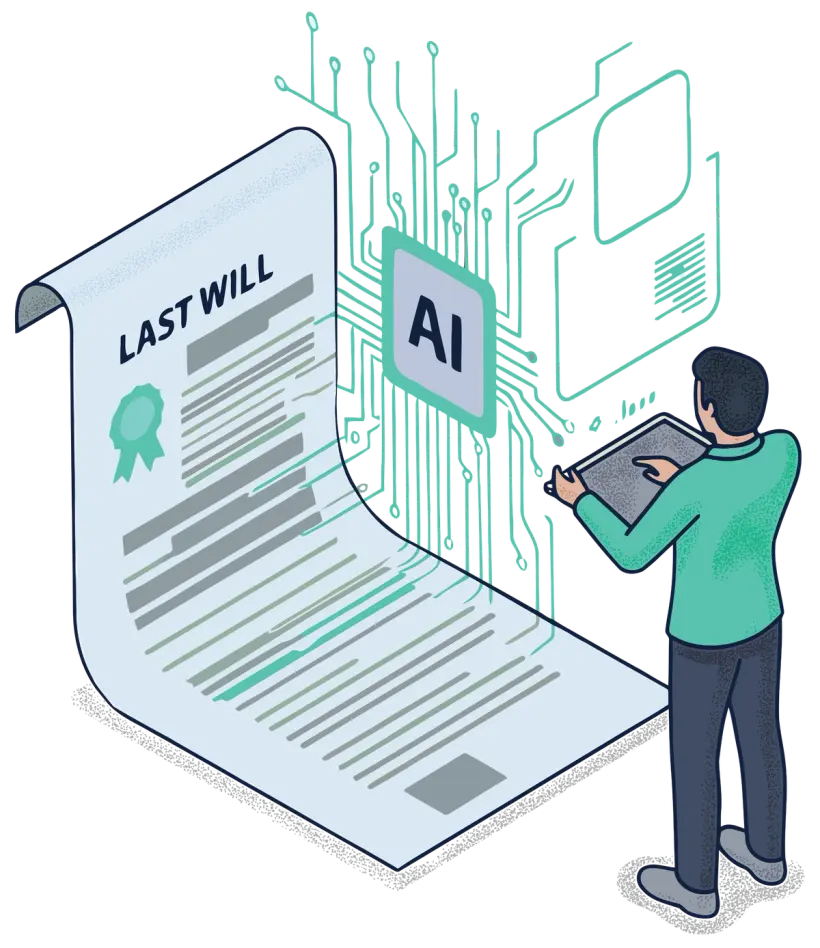
Artificial intelligence is reshaping how people access legal tools. At TheWill.ai, we think that is a genuinely good thing, provided it is done responsibly. Our platform uses AI to guide you through creating a legally sound will, but we are deliberate about where AI helps, how your data is protected, and where human oversight steps in. This article explains our approach honestly.
Where AI Helps Us Build a Better Platform
AI is not just involved when you are filling in your will: it supports the development and quality of the platform itself. We use AI across four areas:
- Development and code quality: our engineering team uses AI assistance to write, review, and optimise the software that powers TheWill.ai, helping us move quickly without sacrificing reliability.
- Document organisation: AI helps categorise, structure, and cross-reference the large body of legal clauses, jurisdictional requirements, and template logic that underpins every will we generate.
- Quality assurance and testing: AI-assisted testing lets us check that the platform behaves correctly across the many combinations of circumstances, assets, and beneficiary arrangements our users bring.
- Data analysis and product insights: aggregated, anonymised usage patterns help us understand where users find the process confusing and where we can improve guidance, without ever linking insights to individual identities.
The Three-Step Generation Process
When you create a will on TheWill.ai, your document goes through a structured, layered process designed to combine the consistency of rules with the flexibility of AI, plus a qualified professional who reviews every will before it is finalised.
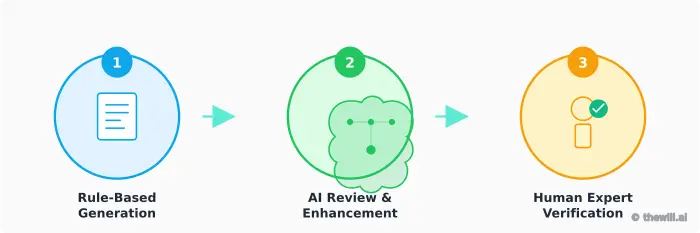
Step 1: Rule-Based Generation
The foundation of every will is deterministic: a rules engine applies the legal requirements for your jurisdiction, selects the appropriate standard clauses, and ensures the document structure meets formal validity requirements. This step does not rely on AI at all: it is logic that our legal and technical team has carefully codified and tested.
Step 2: Automated AI Review and Enhancement
Once the rules engine has assembled a draft, our AI systems review and enhance it. This means checking for ambiguous phrasing, suggesting clearer language, and flagging combinations of choices that might warrant closer attention. One example is where an unusual asset type interacts with a beneficiary arrangement in a way that deserves an explicit clause. AI makes the language more readable and the document more complete, without overriding the legal structure set in step one.
Step 3: A Professional Reviews Every Will
AI prepares the first draft and checks it against the rules. Then a qualified professional you choose reviews every will in full before it can be finalised.
People make the final decisions. The AI does the routine work.
Data Privacy and Anonymisation
By default your answers are processed on our own servers. You can choose a quicker outside AI provider instead. That only happens if you tick a separate consent box, and personal details are replaced with placeholders first:
- Your name becomes [PERSON_NAME]
- Your address becomes [ADDRESS]
- Asset values become [AMOUNT]
- Dates of birth and other dates become [DATE]
An outside provider you consent to works only on this placeholder version. When its output is applied back to your document, the placeholders are swapped for your real details on our own servers.
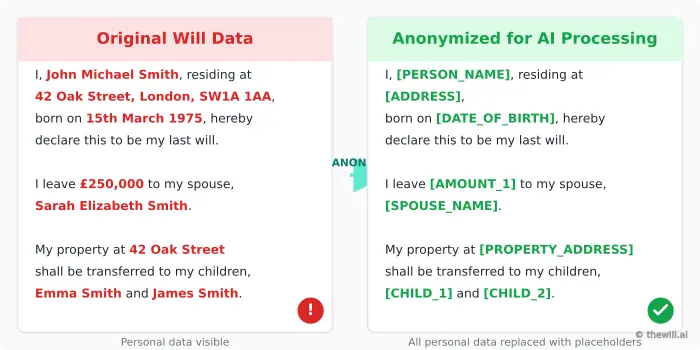
This design supports our obligations under UK GDPR and data-protection law more broadly. Unless you tick the separate consent box, your answers stay on our own servers.
AI Limitations and How We Mitigate Them
We believe in being honest about what AI cannot do. Large language models can produce plausible-sounding text that is factually or legally incorrect, a phenomenon sometimes called hallucination. They may also struggle with:
- Jurisdiction-specific nuances: the rules governing wills vary significantly between England and Wales, Scotland, Northern Ireland, and other jurisdictions; general AI knowledge is not a reliable guide.
- Complex or unusual situations: highly bespoke asset structures, blended families, or cross-border considerations require care that goes beyond pattern-matching.
- Emotional and contextual sensitivity: AI does not understand the full personal context behind your wishes in the way that a person who knows you would.
- Evolving law: legal requirements change, and AI systems trained on historical data may not reflect the most recent position.
We mitigate these limitations through the layered architecture described above: the rules engine provides a legally correct scaffold that AI cannot override; automated checks flag potential issues rather than resolving them silently; and the exception path exists precisely for situations that fall outside what the automated system handles confidently. We also keep our rules engine updated as law changes.
Our Responsible-AI Commitments
We hold ourselves to the following principles in how we develop and deploy AI on TheWill.ai:
- Transparency: we tell you where and how AI is used, rather than presenting it as a black box.
- Privacy by design: your answers are processed on our own servers by default; an outside AI provider is used only with your separate consent, and personal details are replaced with placeholders first.
- Accuracy over speed: we prioritise generating a correct document over generating a fast one; we do not sacrifice legal accuracy for efficiency.
- Continuous improvement: we monitor the quality of outputs, act on issues we find, and update the rules engine and AI components as we learn more.
- Honest limits: we do not claim that AI makes our platform infallible, and we maintain the exception path for cases where automation falls short.
- No regulatory overreach: we make no claims about regulatory status or legal advice; TheWill.ai is a guided self-service tool, not a substitute for professional legal counsel when your circumstances require it.
What This Means for You
The result of this approach is a will-creation experience that is quicker and more affordable than traditional routes, while being grounded in real jurisdictional rules and built with your data privacy at its core. We are straightforward about the role of automation and its limits, because we think you deserve to know how the tool you are trusting actually works.
If you have questions about our approach before you start, you are welcome to read our privacy policy (opens in a new tab) or contact our team. When you are ready, you can begin creating your will. The process is guided, step by step, at your own pace.
Written by
TheWILL.ai Team
The editorial team at TheWILL.ai, dedicated to making estate planning accessible and modern.