What makes an AI agent different from a chatbot
A chatbot answers the question you typed. An agent reads the records you already keep, works out what needs doing and sets it out for you to approve. The difference matters most where the records are about your family.
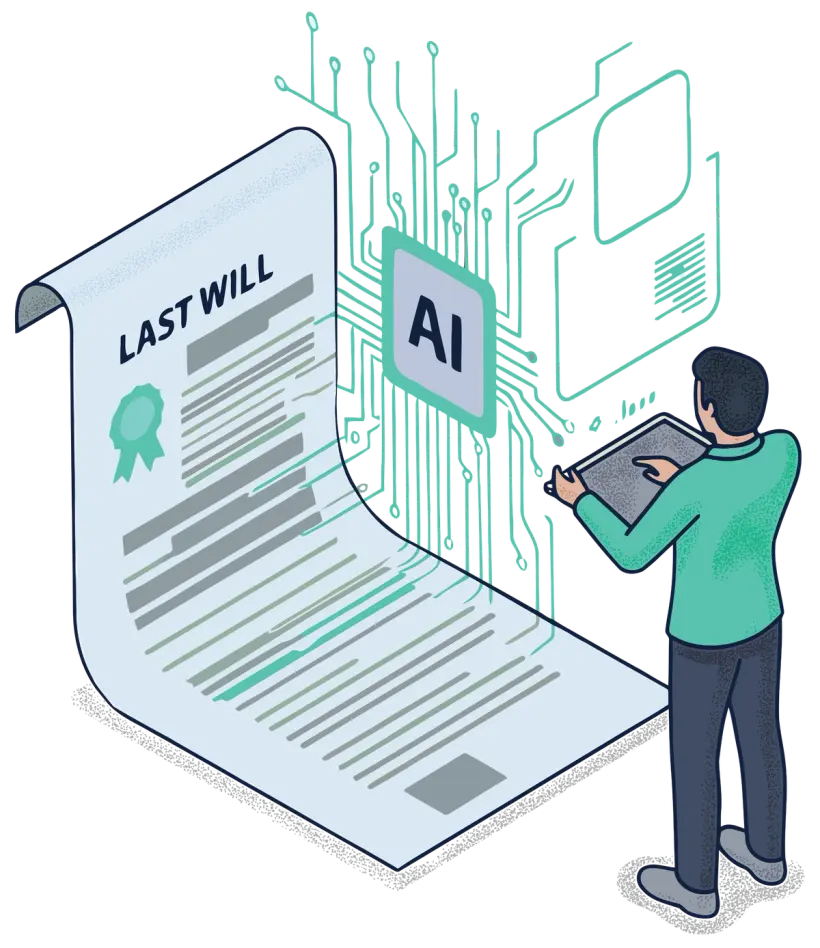
Ask a chatbot what to do after you move house and it will give you a tidy, general list. It does not know that you added a marriage certificate to your vault last month, or who you have already named in your records. It is answering a question, and the question is all it has.
An agent starts from the other end. It reads the records you already keep, works out what has changed and what that touches, and sets each next step out for you to check. The word "agentic" has been stretched to cover almost anything with a language model inside it, so it is worth being precise about what the difference is and why, for anything to do with a will, the last step has to stay with you.
This article is general information about how AI tools work. It is not legal advice, and nothing here describes what the law requires of you or your estate.
A chatbot waits for the question
A chatbot is a conversation. You type, it replies, and the reply is only as good as what you thought to tell it. That is fine for explaining a term or drafting a paragraph you will rewrite anyway. It is weak at the job most people actually have with their affairs, which is noticing what they forgot to ask.
Most of the trouble in an estate is not ignorance of the rules. It is a document that went stale without anyone noticing: a guardian who has since moved abroad, an account that was closed, a property that was sold, a marriage that happened after the will was signed. No one asks a chatbot about the thing they have forgotten.
An agent starts from your records
An agent does three things in order. It reads, it plans, and it proposes.
Reading means looking at what is already there. Not the open internet, and not a guess about your circumstances, but the records you keep with us: the people you have named, whether your will is complete, the certificates in your vault, the days in your residency tracker.
Planning means working out where the change belongs. If you say you moved house in March, the Estate Concierge agent can propose recording the move with that date, and a to-do for anything else you mentioned, such as the home insurance.
Proposing means setting each step out as a suggestion, with the reason and the record it is based on, for you to approve, edit or reject. On our platform this is where the work stops. Every agent we run proposes, and nothing it suggests is written to your records until you approve it.
Why the last step stays with you
There is a version of agentic AI that skips the third step and simply does things. For booking a restaurant, that may be harmless. For records that decide who looks after your children or who inherits your home, it is the wrong design, for three reasons.
Language models are fluent before they are right. A suggestion that reads well can still be wrong about a date, a name or a relationship. Shown to you as a suggestion, a wrong one costs a click. Written straight into your records, it costs whatever it takes to notice.
Your intentions are not in the data. An agent can see that you recorded a divorce. It cannot see whether you want your former partner to remain an executor. Only you can make that call, and a system that makes it for you has guessed.
The record is evidence. A will, a list of beneficiaries or a residency history may one day be read by someone trying to work out what you meant. A change you approved is a change you made. A change a machine made on its own is a question mark.
So on our platform the approval is not a setting you can turn down. It is how the agents are built. Some suggestions, when approved, open the usual form already filled in, so your own Save is the only change. Others apply when you approve them. None of them apply before.
What an agent can and cannot see
The boundaries are worth knowing before you switch one on.
Our agents read through read-only tools. They can look at your records, but the tools they are given cannot change anything, which is why every change has to come back to you as a suggestion.
Those that use a language model run it on our own servers, so your records are not sent to an outside AI service to do it.
And there is one switch. Turning off AI features in your AI settings stops every agent from running for you, and the rest of the platform keeps working as before.
The agents we run, in one paragraph each
Each of these is described in more detail on its own page, and on the AI agents overview.
Estate Concierge agent. You describe what happened in your own words, and it proposes the records and to-dos to update: a life change to record, a plan for later, a certificate to add to your vault. It quotes what you wrote rather than inventing detail. Nothing happens until you approve.
Life-event radar. If you opt in to background suggestions, it notices changes your vault and legal updates already show and suggests reviewing your will or your records. It runs on rules rather than a language model. Nothing changes until you approve.
Executor agent. For someone handling an estate, it suggests gentler wording for one draft letter, and when a reply is stored it suggests how the matching task should move on. It never sets dates, chooses recipients or decides a status. The executor approves every change. There is more on the executor agent page.
Overnight practice agent. For law firms and will writers, it drafts client chasers, matter tasks and payment reminders overnight, ready for the team to approve or reject in the morning. Nothing goes out until someone at the practice approves it.
Charity and employer campaign agents. They draft supporter updates, enquiry replies and staff campaigns from the organisation's own figures, and nothing goes out until someone on the team approves it (for employers, an owner or admin).
What still needs a person, and sometimes a professional
An agent is good at noticing and at drafting. It is not a substitute for deciding what you want, and it is not legal advice. When a suggestion raises a question about what a change in your life means for your will, the useful next step is often to read about it, and the common will mistakes guide covers the situations people most often overlook. Where the answer depends on your circumstances, a qualified professional is the right person to ask.
The test for any tool that calls itself agentic is simple. Ask what it reads, what it is allowed to change, and who approves. If the answer to the last question is not you, it is worth asking why.
Written by
TheWILL.ai Team
The editorial team at TheWILL.ai, dedicated to making estate planning accessible and modern.