Who raises your children if you die? Naming a guardian in your will
A guardian is the person who would bring up your children if no parent could. How an appointment works, who can take the role, why it is separate from the money, and what tends to happen when nobody was named.

 United Kingdom - England and Wales
Most parents have a rough answer to the question in the title. A sister, a close friend, the grandparents. What far fewer have is that answer written down anywhere that counts, and the gap between the two is where the trouble lies. If both parents die while the children are young and nobody was named, the person who ends up raising them is chosen by a process the parents never saw, from people they may never have considered.
What follows covers what a guardian actually is, how an appointment generally works, and what usually happens when none was made.
This article is about England and Wales, where the Children Act 1989 governs guardianship. Scotland and Northern Ireland have their own legislation, and the position below is not theirs. It is general information, not legal advice on any family's arrangements, and the law changes.
What a guardian is, and what a guardian is not
A guardian, in this sense, is someone who takes on the legal responsibility for bringing up a child when no parent is able to. That covers the daily decisions a parent makes without thinking: where the child lives, which school they attend, what medical treatment they receive, which religion if any they are raised in. The guardian stands in the parent's place for those choices.
A guardian is not automatically the person who looks after the child's money. That is a separate job, usually done by trustees under the will, who hold and manage whatever the child inherits until they reach the age the will sets. The two roles can go to the same person, and often do. They can also be split deliberately, so that a warm, practical relative raises the children while a sibling who is careful with paperwork manages the funds. Keeping the two apart also means no single person has to answer for everything at once.
When an appointment takes effect
A common misunderstanding is that naming a guardian means handing the children over the moment you die. In most places it does not work that way. Where a surviving parent still holds parental responsibility, that parent normally carries on, and the appointment waits in the background until there is no parent left to act.
That is why couples usually each name the same person. If one parent names a friend and the other names their own brother, and both die together, the two documents point in different directions. Both people may end up appointed and have to share the role, and if they disagree, a court may be asked to settle it. Nobody writing either will intended that outcome, and it is easy to avoid by comparing notes before either document is signed.
In England and Wales, for example, a parent who holds parental responsibility can appoint a guardian in writing, dated and signed. A will is the most common home for that appointment, though not the only one. A parent without parental responsibility generally cannot make an appointment at all, which catches out some separated and unmarried parents who assumed otherwise.
Who can be named
The broad answers are similar across most systems:
- An adult. A guardian is expected in practice to be an adult, and some systems require it.
- More than one person, if you choose. Two people can be named to act together, which suits a couple who would raise the children as a household.
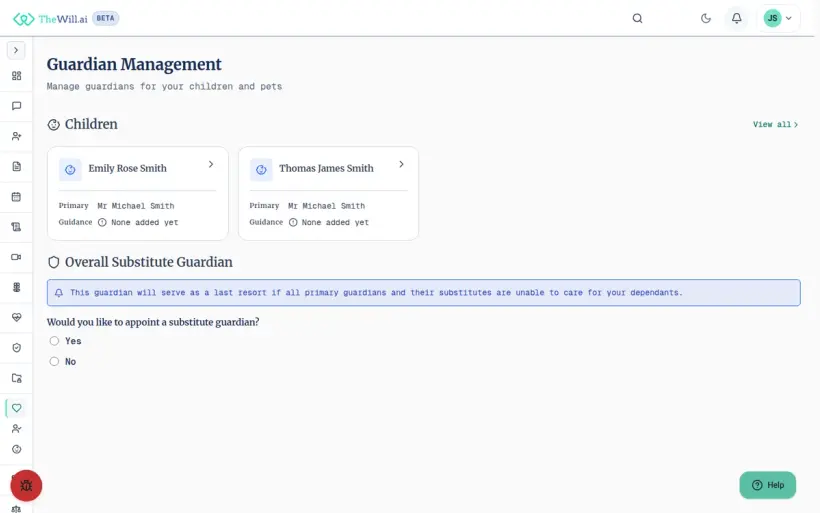
- A backup. A second choice can be named in case the first cannot or will not take the role when the time comes.
- Someone who has agreed. Nobody can be made to accept guardianship. An appointed guardian can usually decline, in England and Wales by a written disclaimer made soon after learning of the appointment, and a surprise appointment is more likely to be turned down than one that was discussed years earlier.
What the law rarely does is tell you who would be best. That judgement belongs to the parents, and the questions that usually shape it are practical rather than legal: where the person lives, whether the children would have to change school or country, how old the person will be in ten years, and whether their own household has room. Writing a short letter alongside the will that explains the choice, and what matters in the children's upbringing, is something many parents do. It is not binding in most places, but it tells a guardian, and a court if it ever comes to that, what the parents wanted.
What happens if nobody is named
The detail varies, but the shape is familiar across many systems. With no surviving parent and no valid appointment, a court decides who will have responsibility for the children. Relatives or friends can usually apply, and in the meantime the local authority or children's services may become involved to make sure the children are cared for. The same gap affects the rest of the estate too, and our guide on what happens without a will covers that side.
A court will generally look at what is best for the children, and it will often reach a sensible answer. The difficulty is what the process costs on the way. It takes time, at the point when the children most need things to settle. It can set relatives against each other, each sure they know what the parents would have wanted. And the person the parents would have chosen may not apply at all, because they did not know they were the parents' choice.
A decision that changes as the children do
A guardian named when a first child is born may be the wrong person a decade later. People move abroad, separate, fall ill or have large families of their own, and a choice that was obvious once can become unworkable. An appointment is worth revisiting at the moments that already prompt a look at a will: a new child, a move, a change in the guardian's own life.
That is what our young families plan is built around: naming a primary and a backup guardian inside the will, and updating the choice when life changes rather than when it is too late. The guardian appointment is part of the will itself, written alongside everything else an individual will covers.
Naming someone is the part only a parent can do.
Sources
- Children Act 1989, section 5 (appointment of a guardian in writing, dated and signed; takes effect when no parent with parental responsibility survives, subject to section 5(7))
- Children Act 1989, section 6(5) (disclaimer of an appointment in writing within a reasonable time)
Written by
TheWILL.ai Team
The editorial team at TheWILL.ai, dedicated to making estate planning accessible and modern.