Would you let a chatbot write your will in England and Wales?
Nothing in the Wills Act 1837 says who has to draft a will, so a chatbot draft can be valid in England and Wales. Whether it survives depends on two witnesses, a marriage nobody planned for, and evidence your family may one day need.
 United Kingdom - England and Wales
In a 2026 survey of more than 500 members of STEP worldwide, most of them in the UK, the professional body for inheritance and trust practitioners, 15% said they had come across mistakes in wills drafted with AI, and 7% had seen AI-drafted wills that were completely invalid. That is what practitioners have seen across their work, not a failure rate for every will. It does show that the problem has already reached the people who deal with estates after a death.
So can you let a chatbot write your will in England and Wales? The law does not forbid it. What it asks about is everything the chatbot cannot do for you.
What the Wills Act 1837 actually asks
Nothing in the Wills Act 1837 says who has to draft a will. Section 9 generally asks four things: the will is in writing; you sign it, or someone signs for you in your presence and at your direction; you intend your signature to give effect to it; and you sign, or acknowledge your signature, in front of two or more witnesses who are present at the same time, each of whom then signs, or acknowledges their signature, in your presence. You generally have to be 18 to make one.
A chatbot can produce text that meets the first of those. The other three happen in a room, with pen and paper, and the chatbot is not there.
Two witnesses, in the same room, at the same time
The witnessing rule catches people out more than any other. Both witnesses have to see you sign, or hear you acknowledge your signature, while they are present together. Signing in front of one witness on Monday and the other on Tuesday generally does not work.
There is no general route for witnessing over video now. A temporary rule allowed it during the pandemic and came to an end in January 2024. A typed or chatbot will in England and Wales still needs your signature and two witnesses there in person.
Small slips at this stage can be costly to put right. In Marley v Rawlings [2014] UKSC 2, a husband and wife each signed the will prepared for the other by mistake. The will was saved, but only after the case reached the Supreme Court.
The witness who loses their gift
Section 15 of the Act is the rule a chatbot is least likely to warn you about. If a beneficiary, or the spouse or civil partner of a beneficiary, witnesses your will, the gift to that person is generally void. The rest of the will stands, but the person you meant to benefit receives nothing under it. A later Act saves the gift only if the will was properly witnessed without them.
The usual way it happens is ordinary. A neighbour and her husband witness your will, and you have left her your car. A chatbot drafting the words has no way of knowing who will hold the pen.
When marriage or divorce rewrites the plan
Under sections 18 and 18B, marriage or civil partnership generally revokes an earlier will, unless the will shows it was made expecting that particular marriage or civil partnership and was meant to survive it. People who remarry later in life are often surprised to find their old will has gone.
Divorce works differently. Under sections 18A and 18C, a former spouse or civil partner is generally treated as if they had died on the date of the divorce or dissolution, for gifts and for any appointment as executor, unless the will says otherwise. The rest of the will stays in place. A chatbot will not remind you of either rule when your life changes.
What a will cannot override
A will is not always the last word. The Inheritance (Provision for Family and Dependants) Act 1975 lets certain people, including a spouse, a child or someone you were maintaining, ask the court for reasonable financial provision from your estate. A claim generally has to be made within six months of the grant of probate or letters of administration, unless the court gives permission. A chatbot only knows the family you describe to it.
Capacity matters too. If someone later says you did not understand what you were signing, or that you were pressured, the court looks at the evidence of how the will was made. A chat history on your phone says very little about that.
The original has to be found
A will in England and Wales generally works from the signed original, not a copy or a file on a laptop. Under section 20 of the Act, a will can be revoked by a later will, by a signed document saying so, or by burning, tearing or otherwise destroying it with the intention of revoking it.
That last rule has an awkward side. If the original was last known to be with you and cannot be found after your death, the court may presume you destroyed it on purpose, and your estate may then pass as if there were no will. Your family can try to rebut that presumption, but it means evidence, time and cost. A chatbot can save as many copies of the text as you like. It cannot tell your executor where the signed original is.
Reform is coming, but not yet
The Law Commission recommended changes in May 2025, including a power for courts to save a will that misses a formality and a framework for electronic wills. Those are recommendations, not law. Until Parliament acts, the rules above are the ones that apply.
What our service does in England and Wales
Our will service uses AI too, built for wills and estate documents. Like any AI assistant it can misread an answer or word something in a way you did not intend. The difference is what surrounds it.
Drafted for the Wills Act. Your will is drafted for the formalities in England and Wales, and your answers are checked as you enter them. A full check before review flags missing details.
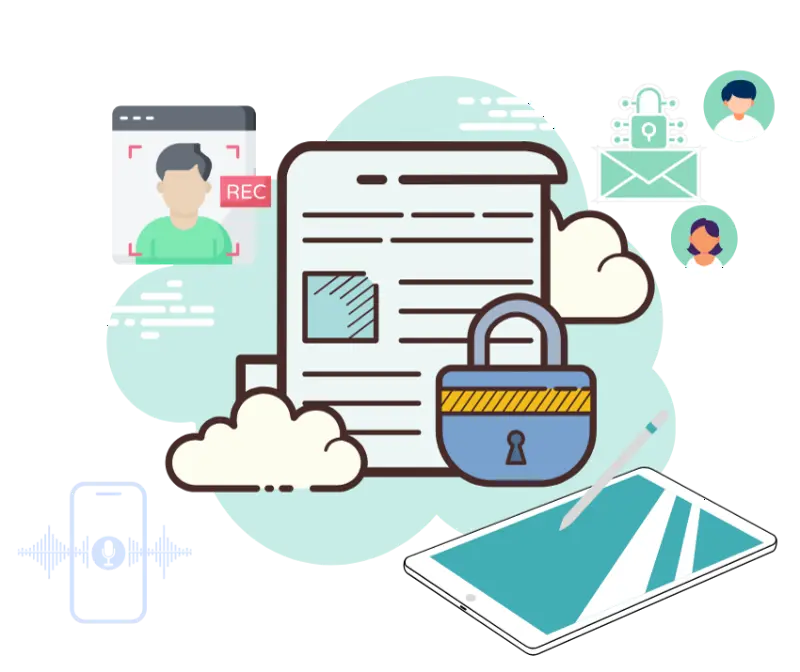
An independent professional before it is final. An independent will writer or solicitor you choose reviews your will and checks your identity before it can be finalised. You can record the consultation.
Signing guidance that names the witness rules. Our guidance sets out the rule of two witnesses present together, and the notes on our England and Wales wills warn that no beneficiary, and no spouse or civil partner of a beneficiary, should witness.
A record of who approved it and when. Every draft carries a record of how it was made, from first entry to signature, and every share you grant appears in your audit log. Our page on AI risks to wills explains how that record answers forgery and deepfake risks.
Found when needed. The will and document location registry records where the signed original is kept and who should be told.
Prompted when life changes. We remind you to review your will from time to time and ask about marriage, divorce and new children.
That adds up to peace of mind of a practical kind: a will drafted for the rules here, checked by a professional, signed properly and easy to find. No service can promise that nobody will ever question a will.
On price, a chatbot may well be cheaper at the start. Our will is a one-time purchase with no lock-in, or you can subscribe for new versions each year. The required review is paid separately to the professional you choose, and updating a will later costs a discounted renewal fee plus a new review.
Who should talk to a professional first
Some situations carry more risk if the wording is not right: a second marriage, children from an earlier relationship, a business, property abroad, a trust, a vulnerable beneficiary, or any real chance of a claim under the 1975 Act. Our guide to using AI to write a will and our guide to common will mistakes go further.
This explains the general position in England and Wales only and is not legal advice. The law can change, and a qualified professional can advise on your own situation.
Sources
Checked November 2026; re-check after changes to the law.
- Wills Act 1837 (opens in a new tab), section 9, legislation.gov.uk, formalities for signing and witnessing
- Wills Act 1837 (opens in a new tab), section 7, legislation.gov.uk, minimum age
- Wills Act 1837 (opens in a new tab), section 15, legislation.gov.uk, gifts to a witness or their spouse or civil partner
- Wills Act 1837 (opens in a new tab), section 18, legislation.gov.uk, revocation by marriage
- Wills Act 1837 (opens in a new tab), section 18B, legislation.gov.uk, revocation by civil partnership
- Wills Act 1837 (opens in a new tab), section 18A, legislation.gov.uk, effect of divorce
- Wills Act 1837 (opens in a new tab), section 18C, legislation.gov.uk, effect of dissolution of a civil partnership
- Wills Act 1968 (opens in a new tab), section 1, legislation.gov.uk, when a beneficiary's witnessing is disregarded
- Wills Act 1837 (opens in a new tab), section 20, legislation.gov.uk, how a will is revoked
- Inheritance (Provision for Family and Dependants) Act 1975 (opens in a new tab), section 4, legislation.gov.uk, time limit for claims
- Wills Act 1837 (Electronic Communications) (Amendment) (Coronavirus) Order 2020 (opens in a new tab), legislation.gov.uk, the temporary video-witnessing rule
- Wills Act 1837 (Electronic Communications) (Amendment) Order 2022 (opens in a new tab), legislation.gov.uk, extending that rule to wills made by 31 January 2024
- [Marley v Rawlings [2014] UKSC 2](https://www.supremecourt.uk/cases/uksc-2012-0057), The Supreme Court
- Law Commission: Wills project (opens in a new tab), Law Commission
- STEP members on AI-drafted wills (opens in a new tab), Legal Futures, 21 May 2026
Written by
TheWILL.ai Team
The editorial team at TheWILL.ai, dedicated to making estate planning accessible and modern.