Writing your will with a chatbot in Hong Kong
A will in Hong Kong is signed in front of two witnesses present together. A chatbot can write the words, but it cannot see the signing, the wedding that revokes the will or the relative who can go to court.

 Hong Kong
A will in Hong Kong generally has to be in writing and signed by you, or by someone else in your presence and at your direction. Section 5 of the Wills Ordinance (Cap. 30) asks for that signature to be made or acknowledged by you in front of two or more witnesses who are present at the same time, and each witness then attests and signs, or acknowledges his or her signature, in your presence.
None of that cares who wrote the words. A will drafted with a chatbot can be valid in Hong Kong. Most of what decides whether it works happens after the text is finished.
Two witnesses at once, then their signatures
The two witnesses have to be there together when you sign or acknowledge your signature. One on a Saturday and one on a Sunday generally does not meet section 5. Section 4 says a will made by someone who has not attained full age is generally not valid, with exceptions for married people, people in actual naval, military or air force service and mariners or seamen at sea. Full age is 18 under section 2 of the Age of Majority (Related Provisions) Ordinance (Cap. 410).
Where a will does fall short of these steps, the court may still be able to treat it as duly executed under section 5(2), but only on application and where it is satisfied that there can be no reasonable doubt that the document embodies your testamentary intentions. That is a high bar and a court case, not a safety net to plan around.
Who should not witness
Under section 10, a gift to a witness, or to a witness's husband or wife, is generally void so far as it concerns that witness or spouse, while the rest of the will stands. Section 10(3) disregards the attestation of such a witness if the will is duly executed without it and without that of any other such person. A chatbot drafting a gift to your sister cannot know that her husband is the neighbour you plan to ask to witness.
A wedding can end the will
Section 14 provides that a will is generally revoked by the testator's marriage (section 13 lists marriage among the ways a will can be revoked). There are exceptions, including where it appears from the will that, when it was made, the testator was expecting to marry a particular person and intended that the marriage should not revoke it. A will drafted years before a wedding may no longer exist in law afterwards, and nothing about the wedding gives notice of that.
The family can still ask the court
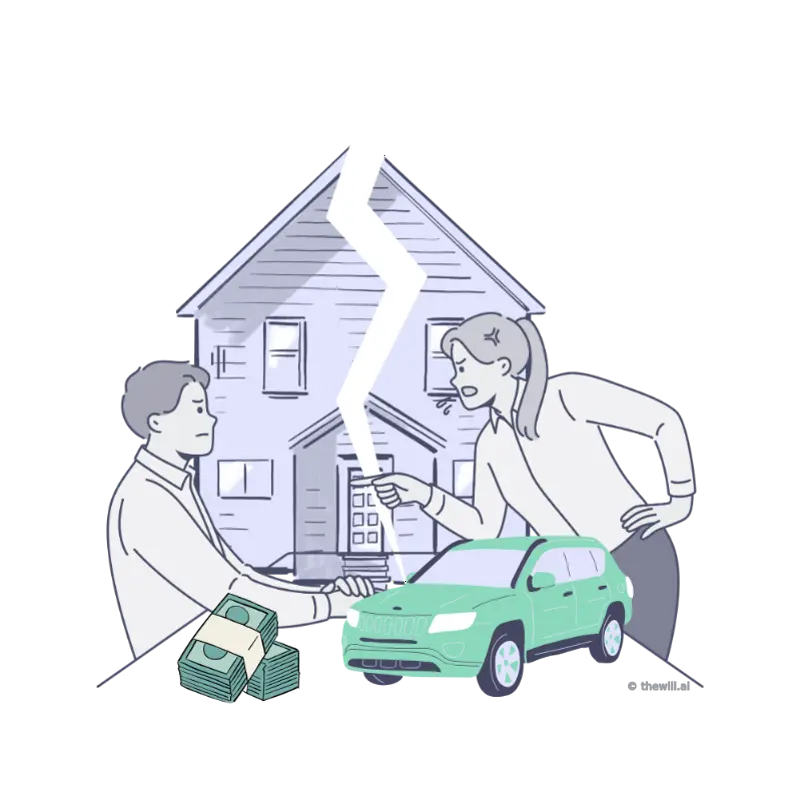
A valid will is not always the last word. The Inheritance (Provision for Family and Dependants) Ordinance (Cap. 481) lets certain family members and dependants ask the court for reasonable financial provision from the estate. Under section 6, an application generally cannot be made, without the court's permission, after six months from the date on which representation for the estate is first taken out.
A chatbot only knows the family you describe. It cannot weigh how a court might view a will that leaves out a spouse, a child or someone you were supporting.
What to check before you sign
1. Does the will deal with everything, including whatever is left after specific gifts? 2. Will you sign, or acknowledge your signature, with both witnesses there together? 3. Is either witness, or their spouse, someone the will benefits? 4. Have you married, or are you about to, since the will was drafted? 5. Is anyone likely to say they were left without reasonable provision?
Where we stand in Hong Kong
We do not prepare a will for Hong Kong at present, and nothing in this post should be read as saying we do. Our Hong Kong guide to using AI to write a will goes through the checks above in more detail, and our guide to whether you need a solicitor compares the routes. A local solicitor can deal with the signing, the revocation rule and Cap. 481 as they apply to you.
This explains the general position in Hong Kong only and is not legal advice. The law can change, and a qualified professional can advise on your own situation.
Sources
Checked November 2026; re-check after changes to the law.
- Wills Ordinance (Cap. 30) (opens in a new tab), section 4, persons not of full age, Hong Kong e-Legislation
- Wills Ordinance (Cap. 30) (opens in a new tab), section 5, signing and witnessing, and the court's power where formalities are not met (s.5(2))
- Wills Ordinance (Cap. 30) (opens in a new tab), section 10, gifts to an attesting witness or their spouse
- Wills Ordinance (Cap. 30) (opens in a new tab), sections 13 and 14, modes of revocation and revocation by marriage
- Age of Majority (Related Provisions) Ordinance (Cap. 410) (opens in a new tab), section 2, full age is 18
- Inheritance (Provision for Family and Dependants) Ordinance (Cap. 481) (opens in a new tab), sections 3 and 6, applications for reasonable financial provision and the six-month time limit
Written by
TheWILL.ai Team
The editorial team at TheWILL.ai, dedicated to making estate planning accessible and modern.