Writing your will with a chatbot in the United States
There is no single American law of wills. Texas, California and New York each set their own signing and witnessing rules, and a chatbot draft that works in one state can fail in the next.
 United States
In New York, your two witnesses have up to thirty days between them to sign your will. In California two witnesses generally have to be present together when you sign or acknowledge your will. In Texas a will written entirely in your own handwriting needs no attesting witnesses. Those are three states, three sets of rules, and no general answer covers the other forty-seven.
That is the first thing to know about asking a chatbot to write a will in the United States. No state requires you to use an attorney to make your own will, so a draft written with a chatbot's help can be valid. But validity is decided by the law of a particular state, and this post looks only at the three named here. If you live anywhere else, check your own state's rules.
Texas: two witnesses, or your own handwriting
The Texas Estates Code, chapter 251, generally requires a will to be in writing, signed by you, and attested by two or more credible witnesses aged at least 14, who sign in your presence (section 251.051).
Section 251.052 allows a will written wholly in your own handwriting to be valid without attesting witnesses. That rule does not help a chatbot draft. A printed document is not handwritten, so a typed will that was never witnessed is unlikely to be rescued by it.
Texas also lets you make a will self-proved with a self-proving affidavit (section 251.101), which can make the probate stage simpler.
California: a safety net, with conditions
Under section 6110 of the California Probate Code, a will generally has to be in writing, signed by you, and signed by at least two witnesses who, being present at the same time, saw you sign or heard you acknowledge your signature or the will, and who understood that the document they sign is your will.
California has a safety net. Where a will was not executed that way, section 6110 allows it to be treated as validly executed if the person relying on the will shows by clear and convincing evidence that, when you signed it, you intended it to be your will. That means proof in court, so it is a rescue, not a plan.
Section 6112 deals with witnesses who benefit. An interested witness does not make the will invalid, but unless there are two other witnesses who are disinterested, a gift to that witness is presumed to have been obtained by duress, menace, fraud or undue influence, a presumption the witness can try to rebut. A chatbot cannot see who you ask to sign.
New York: thirty days and a declaration
New York's Estates, Powers and Trusts Law, section 3-2.1, generally requires you to sign at the end of the will, in the presence of each attesting witness or by acknowledging your signature to each of them. You also declare to each witness that the document is your will, and at least two witnesses attest within one thirty-day period.
Handwritten wills are valid in New York only in narrow cases, such as members of the armed forces in actual service during a war or armed conflict (and people serving with or accompanying them), and mariners at sea (section 3-2.2). Even then they lapse after a set time. A gift to an attesting witness is generally void unless there are at least two other attesting witnesses who take nothing under the will (section 3-3.2).
New York has also legislated for electronic wills. The amended text of section 3-2.1 that refers to them is marked as taking effect on 12 December 2027, so until then the paper rules above are the ones to follow.
Why one draft does not travel
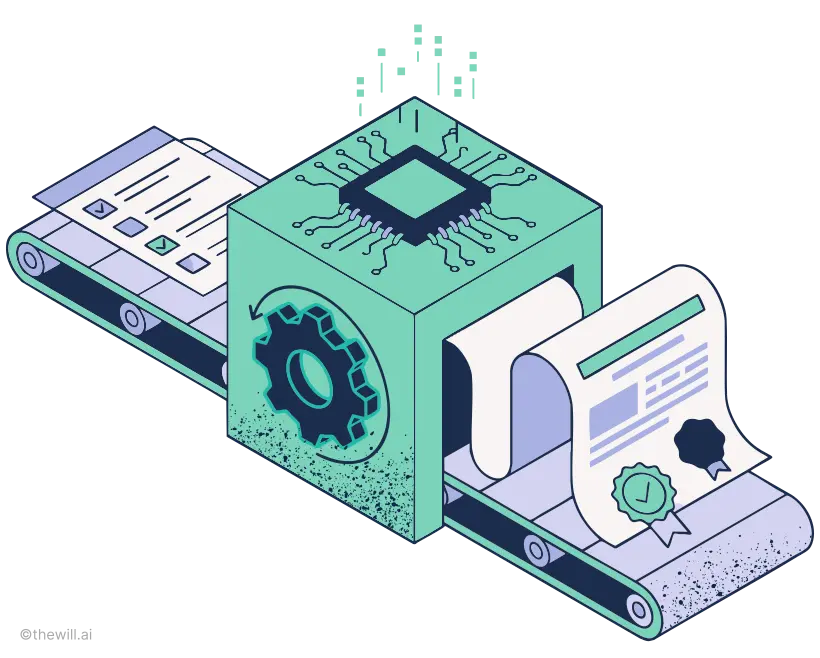
A chatbot will usually produce one confident document. It does not know which state's rules will be applied unless you tell it, and even then it cannot stand beside you while you sign. A will that is valid in Texas because it is handwritten may not be valid on the same facts in New York. If you move, own property in another state or have family spread across several, the question of which law applies is one for a professional, not a chat window.
What we do in each state
What we can offer depends on where you live.
- In some states we offer our own will. Our will service uses AI too, built for wills and estate documents, and like any AI tool it can misread an answer. What surrounds it is the difference: an independent professional you choose reviews your will before it can be finalised, a witness instruction sheet comes with your will to help with signing and witnessing, and we record who approved your will and when.
- In Texas and Wyoming the will comes with a notice set for that state: "This product is not a substitute for the advice of an attorney."
- In other states our understanding is that preparing a will for someone else, as a business, is reserved to a qualified local firm, so we do not draft it there. You can answer our guided questions and pass the result to a firm you choose.
Our page on AI risks to wills explains why a record of approval matters, and the will and document location registry records where the signed original is kept. Peace of mind, in practice, is a will checked by a person and signed the way your state expects.
Where we offer it, our will is a one-time purchase with no lock-in. The required review is paid separately to the professional you choose, and updating a will later costs a discounted renewal fee plus a new review.
Check your own state
Our guide to using AI to write a will in the US covers what to check, our legal guides hub lists the state guides, and our guide to whether you need an attorney weighs up the routes. Blended families, a business, property in more than one state and any real chance of a challenge are the cases where an attorney's advice is usually worth having.
This explains the general position in Texas, California and New York only and is not legal advice. Rules differ by state and can change, and a qualified professional can advise on your own situation.
Sources
Checked November 2026; re-check after changes to the law.
- Texas Estates Code, chapter 251 (opens in a new tab), sections 251.051, 251.052 and 251.101, written and attested wills, holographic wills and self-proving affidavits
- California Probate Code, section 6110 (opens in a new tab), execution and the clear and convincing evidence rule
- California Probate Code, section 6112 (opens in a new tab), interested witnesses
- New York Estates, Powers and Trusts Law, section 3-2.1 (opens in a new tab), execution and attestation, and the amended text marked effective 12 December 2027
- New York Estates, Powers and Trusts Law, section 3-2.2 (opens in a new tab), nuncupative and holographic wills
- New York Estates, Powers and Trusts Law, section 3-3.2 (opens in a new tab), gifts to attesting witnesses
Written by
TheWILL.ai Team
The editorial team at TheWILL.ai, dedicated to making estate planning accessible and modern.